Support justice-driven, accurate and transparent news — make a quick donation to Truthout today!
Iran’s missile arsenal is still largely intact, according to U.S. and other intelligence agencies, contradicting claims made by the Trump administration.
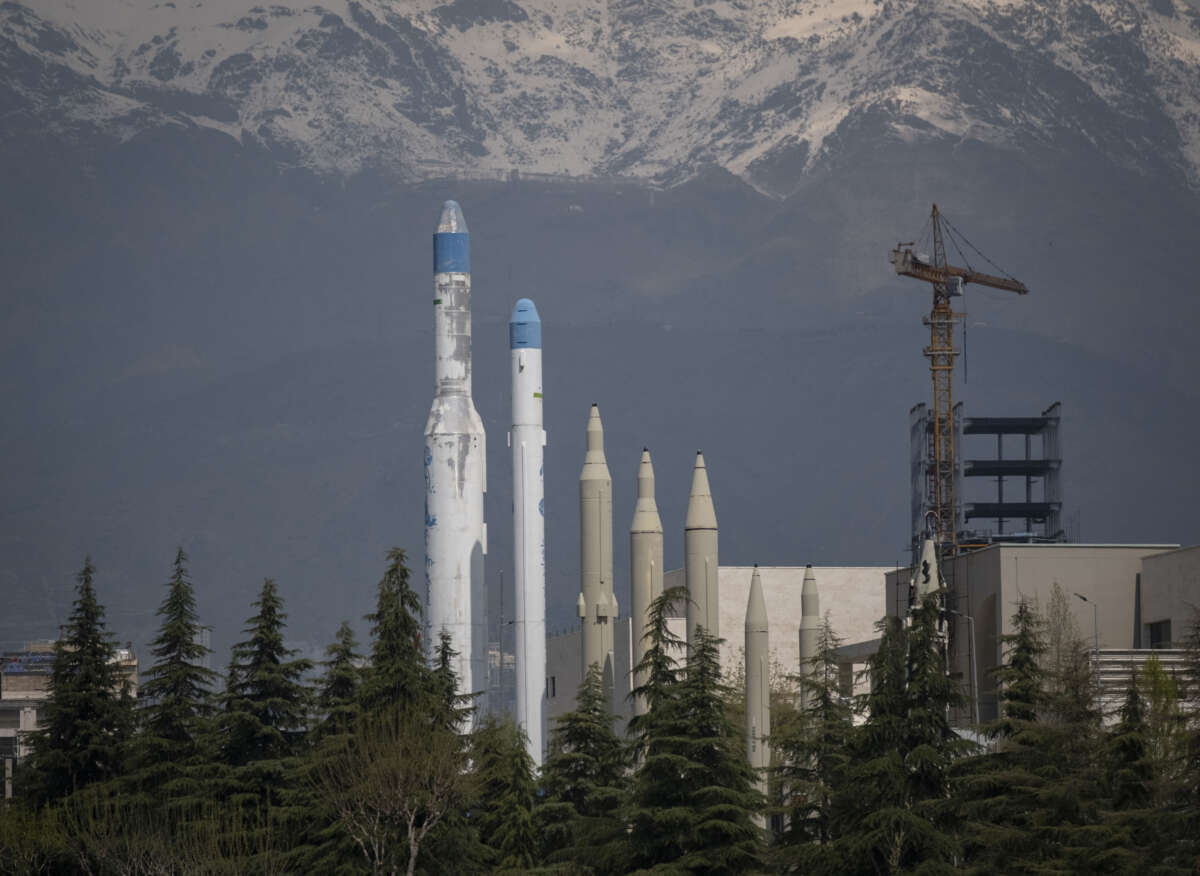
Iran has regained access to 30 of its 33 missile sites along the Strait of Hormuz, as well as to the majority of its mobile launchers and underground facilities, according to a report by The New York Times. These missile sites can be used against U.S. warships that enter the Strait. Only three of the missile sites along the Strait remain inaccessible — and Iran can use its mobile launchers to move missiles to other locations, as well.
Iran still has access to some 70 percent of its prewar missile stockpile, according to The New York Times’s sources, including both ballistic and cruise missiles for both long and short-range targets. Additionally, Iran has regained access to around 90 percent of its underground missile storage and launch facilities across the country.
The Independent published a similar report, citing senior NATO sources in Europe who estimated that Iran has “at least 60 percent” of its prewar military capability.
These sources contradict claims made by Trump, who has repeatedly stated that Iran has been “decimated” over the course of the two-month-long war. Defense Secretary Pete Hegseth has also claimed that Iran’s military has been “severely damaged.” In April, Hegseth declared that “Operation Epic Fury decimated Iran’s military and rendered it combat ineffective for years to come,” and that “Iran begged for this ceasefire, and we all know it.”
Last week, a confidential CIA analysis determined that Iran could survive the U.S.’s naval blockade for at least three to four more months, also calling into question claims by the Trump administration about a swift U.S. victory and end to the war. This was a day after Trump claimed that Iran’s “missiles are mostly decimated, they have probably 18, 19 percent, but not a lot by comparison to what they had.”
According to The Washington Post, one of the U.S. officials who commented on Iran’s capacity said that it would be able to endure even longer than the three to four months estimated by the CIA. “The leadership has gotten more radical, determined and increasingly confident they can outlast U.S. political will,” the official said. “Comparatively, you see similar regimes lasting years under sustained embargoes and airpower-only wars.”
Yesterday, Trump attacked the press again on social media, declaring it “virtual TREASON” to report that Iran’s military remains largely intact. “They are aiding and abetting the enemy!” he continued, likely in response to the Times’s reporting that cites U.S. intelligence sources contradicting his claims.
Joel Valdez, the acting Pentagon press secretary, responded to the Times’s questions about its findings by saying in a statement, “It is so disgraceful that The New York Times and others are acting as public relations agents for the Iranian regime in order to paint Operation Epic Fury as anything other than a historic accomplishment.”
While Iran has retained much of its stock of weapons, the U.S. military has depleted many of its missile stocks — though the administration denies this, too.
As part of its attempt to withhold information about damage from the U.S.-Israeli war on Iran, the administration has also required satellite imagery providers to “implement an indefinite withhold” of imagery from across much of the Middle East. Satellite imagery from Iran, Iraq, Israel and the Occupied Territories, Lebanon, and the Gulf states are now all restricted – though the U.S. government still has unrestricted access to the imagery. This prevents researchers, and the public, from assessing strike damage both on Iran and on, for example, U.S. military bases across the region — which the administration has tried to downplay.
Press freedom is under attack
As Trump cracks down on political speech, independent media is increasingly necessary.
Truthout produces reporting you won’t see in the mainstream: journalism from the frontlines of global conflict, interviews with grassroots movement leaders, high-quality legal analysis and more.
Our work is possible thanks to reader support. Help Truthout catalyze change and social justice — make a tax-deductible monthly or one-time donation today.